
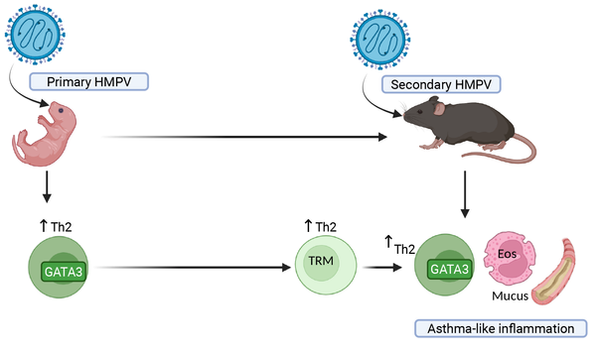
Early life respiratory viral infections
Viral infections in the lung are a major cause of morbidity and mortality in young children. Infections like human metapneumovirus (HMPV), RSV, and influenza cause millions of globally in children under the age of 5. Infants and neonates tend to have worse outcomes with these infections. Viral infections early in life are also associated with an increased risk of development of asthma and have long-term lung function deficits.

HMPV (yellow) infecting a neonatal lung
Asthma
Asthma is the most common chronic condition in childhood. Asthma is frequently diagnosed in young children and results in a high number of missed school days, emergency department visits, and hospitalizations. Care for children with asthma is a priority for Dr. Eddens and understanding how viral infections connect to asthma development could lead to novel strategies to treat this condition.
A mucus plug (center) in a mouse model of asthma after early life viral infection


Summary of differences in the developing immune system. See Eddens et al. 2022 Frontiers in Immunology for full details.
The developing immune system
One reason neonates and infants may have worse outcomes with common infections is the regulation of the developing immune system. Neonatal immune responses tend to be less inflammatory and designed to promote tolerance more so than adult immune responses. The underlying differences in the immune system in young children is critical to understand in the context of viral infections and asthma.
2026
Brown, E.*, Lan, J.*, Fan, L., Lou, D., McCray, A., Manni, M.L., Parks, O.B., Chen, K., Eddens, T. 2026. Early life viral infection generates pathologic tissue resident memory cells that contribute to asthma-like airway disease in mice. JCI Insight. Mar 10:e198712. *denotes co-first authors.
2025
Brown, E., Parks, O.B., Hinck, C.S., Hinck, A.P., Williams, J.V., Eddens, T. 2025. Th1 differentiation and function is inhibited in neonates following human metapneumovirus infection. Journal of Immunology. 2025 Jul 1;214(7):1827-1838.
2025
Lan, J., McCray, A., Brown, E., Eddens, T. 2025. Early life viral infections and asthma—new cells and ideas. Current Opinion in Peds. 2025 Dec 1;37(6):597-605.
2024
Eddens, T.*, Parks, O.B.*, Lou, D., Fan, L., Sojati, J., Ramsey, M.J., Schmitt, L., Salgado, C., Reyes-Mugica, M., Oury, T., Byersdorfer, C., Chen, K., Williams, J.V. 2024. C1q potentiates CD8+ T cell effector function following respiratory viral infection. * denotes co-first authors. AJRCMB. 2024 Sep;71(3):294-306.
2024
Eddens, T., Parks, O.B., Zhang, Y., Manni, M.L., Williams, J.V. 2024. PD-1 signaling in neonates restrains CD8+ function and protects against respiratory viral immunopathology. Mucosal Immunology. Jun;17(3):476-490.
2022
Eddens, T., Parks, O.B., Williams, J.V. 2022. Neonatal Immune Responses to Respiratory Viruses. Front. Immun. Apr 14;13:863149.